Pre-launchThe Commander is planned for Kickstarter in April 2027, once a working prototype has been tried in the water. No board has been built yet and nothing is on sale. Get told when it opens.
SubCommanderTell me at launch

Planned for Kickstarter · April 2027

Dive control on one board

The SubCommander Commander works both ballast tanks and the dive planes, holds depth and trim, and brings the boat up when something goes wrong. You set it up from a phone, on a page the boat serves itself. Its firmware source will be published in full.

Designed and rule-checked. Firmware run on a simulated boat. Not yet built. A hand-wired prototype comes next.

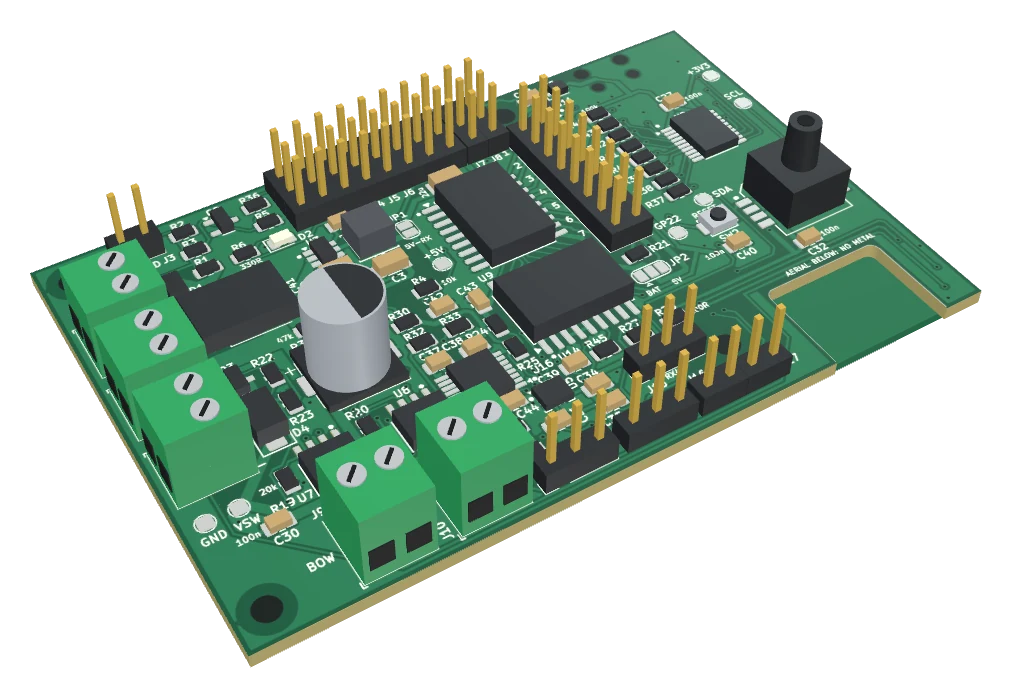
The Commander board seen from an angle: screw terminals down the left edge, rows of pins along the top, the pressure sensor on the right and a cut-out at one corner for the aerial.

A 3D model made from the board's manufacturing files, with simple blocks for the parts. Not a photograph: no board has been built yet.

The range

The Commander first

One board is planned for the campaign. Two more are designed and wait their turn.

The Commander board

Commander

80 × 52 mm · 8 radio channels · Kickstarter, April 2027

Two piston tanks, both sets of planes, depth and pitch regulators, leak and battery watch, an emergency gas blow, lights and two torpedo releases. Built on a Raspberry Pi Pico 2 W.

£89planned pledge · early bird £79
About the Commander
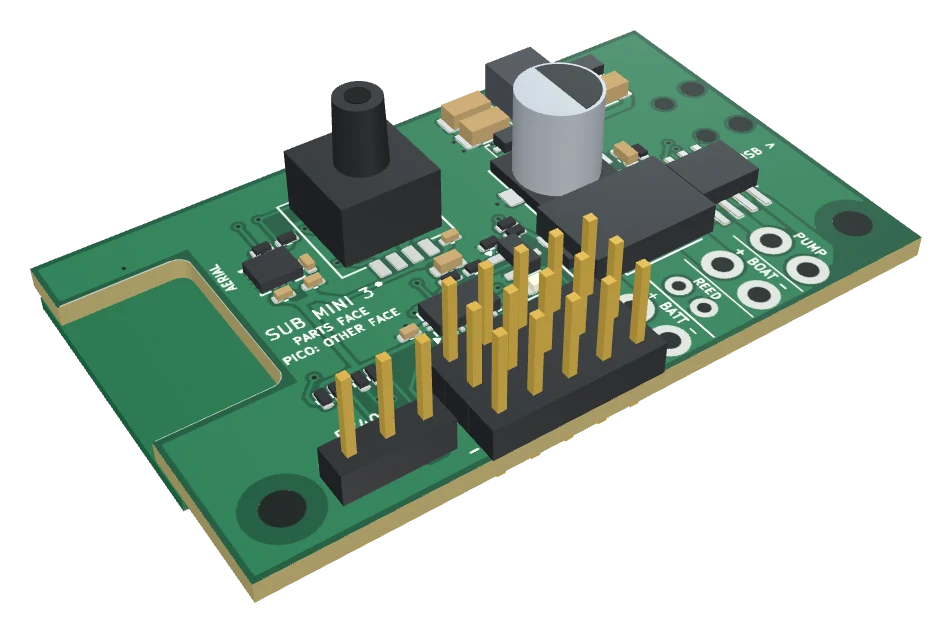
The Mini board, parts face

Mini

Coming later · 51 × 31 mm · 3 radio channels

The small one, for boats with one ballast pump that runs both ways. Two plane servos, depth and pitch regulators, and a failsafe for lost signal and for going too deep.

Coming laterno price yet
About the Mini
The RX40 receiver board

RX40

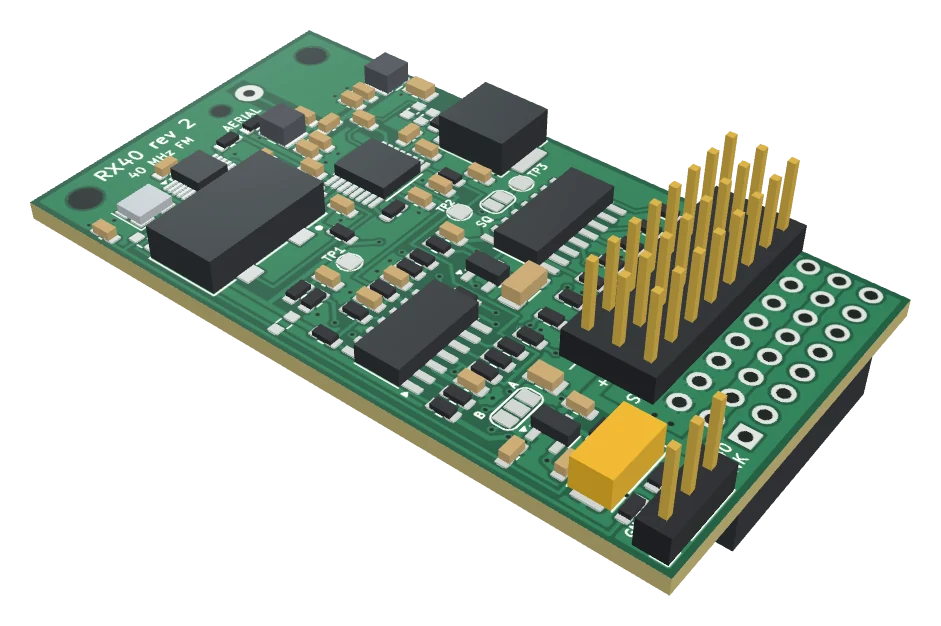
Coming later · 40 MHz receiver · 34 channels

A 40 MHz FM receiver with no receiver crystals to change. A synthesiser takes the crystal's place and the channel is picked on the phone. The Commander has the connector for it.

Coming laterno price yet
About the RX40

The pictures are 3D models made from the board files, not photographs. Postage is extra. The planned pledge levels.

Setup

Set up from a phone

The Commander makes its own Wi-Fi network. Join it, open 192.168.4.1 in the phone's browser, and the setup page is there.

  • Nothing to install. No app, no account and no internet. The page lives on the board.
  • Live readings. Depth, pitch, the tanks, the battery and every radio channel, as the board sees them.
  • Every setting has a labelled control. Change it, try it, then save it to the boat.
  • Bench mode. Move a piston by hand while the boat is open on the bench.

Wi-Fi does not pass through water, so the page is for the bench and the surface. Under water the boat is driven by your radio set, as it always was.

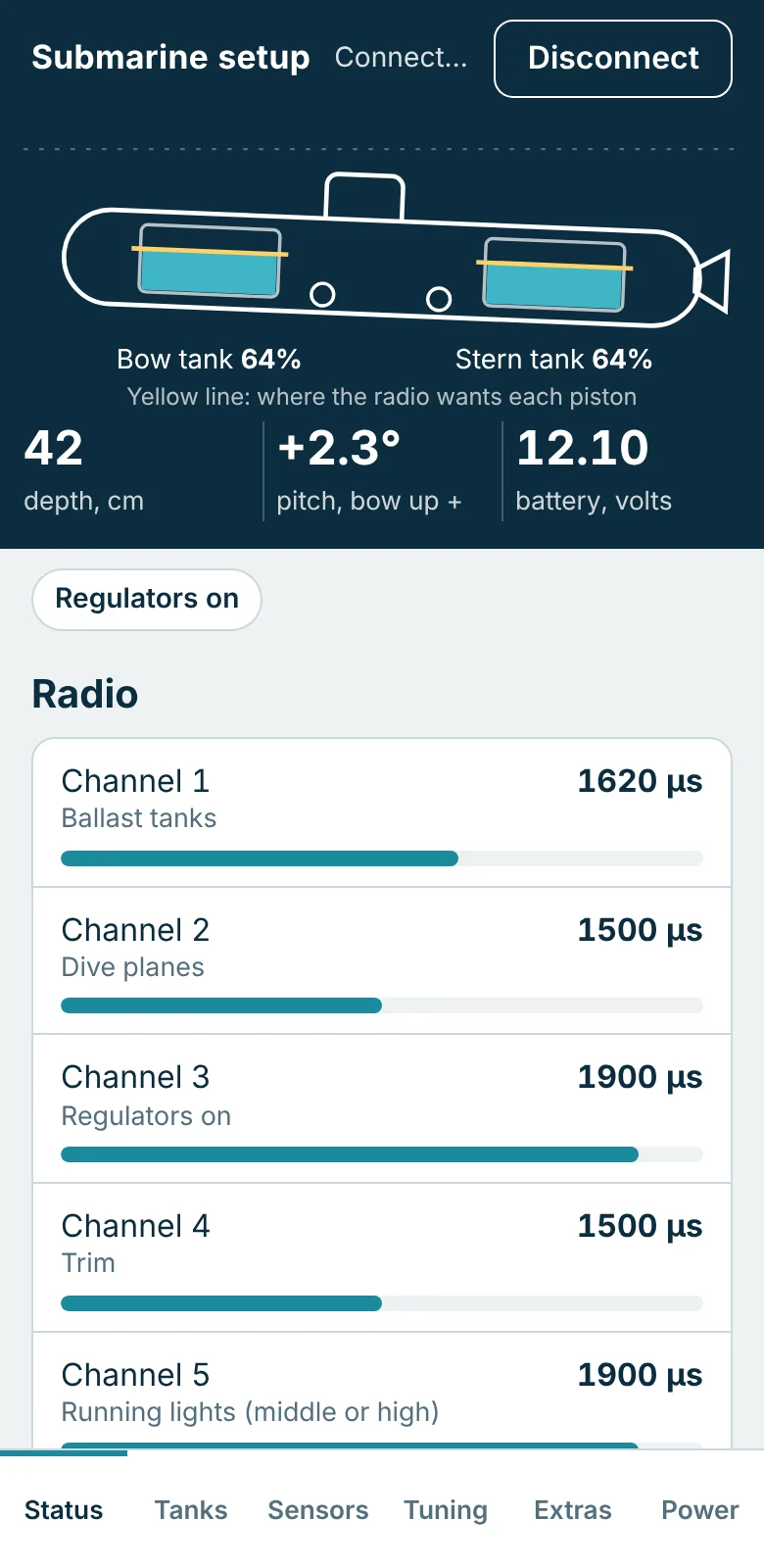
Setup page, Status tab: a submarine outline with two tanks at 64 per cent, depth 42 cm, pitch +2.3 degrees, battery 12.10 volts, and bars for the radio channels.
StatusTank levels, depth, pitch and battery, with every radio channel below.
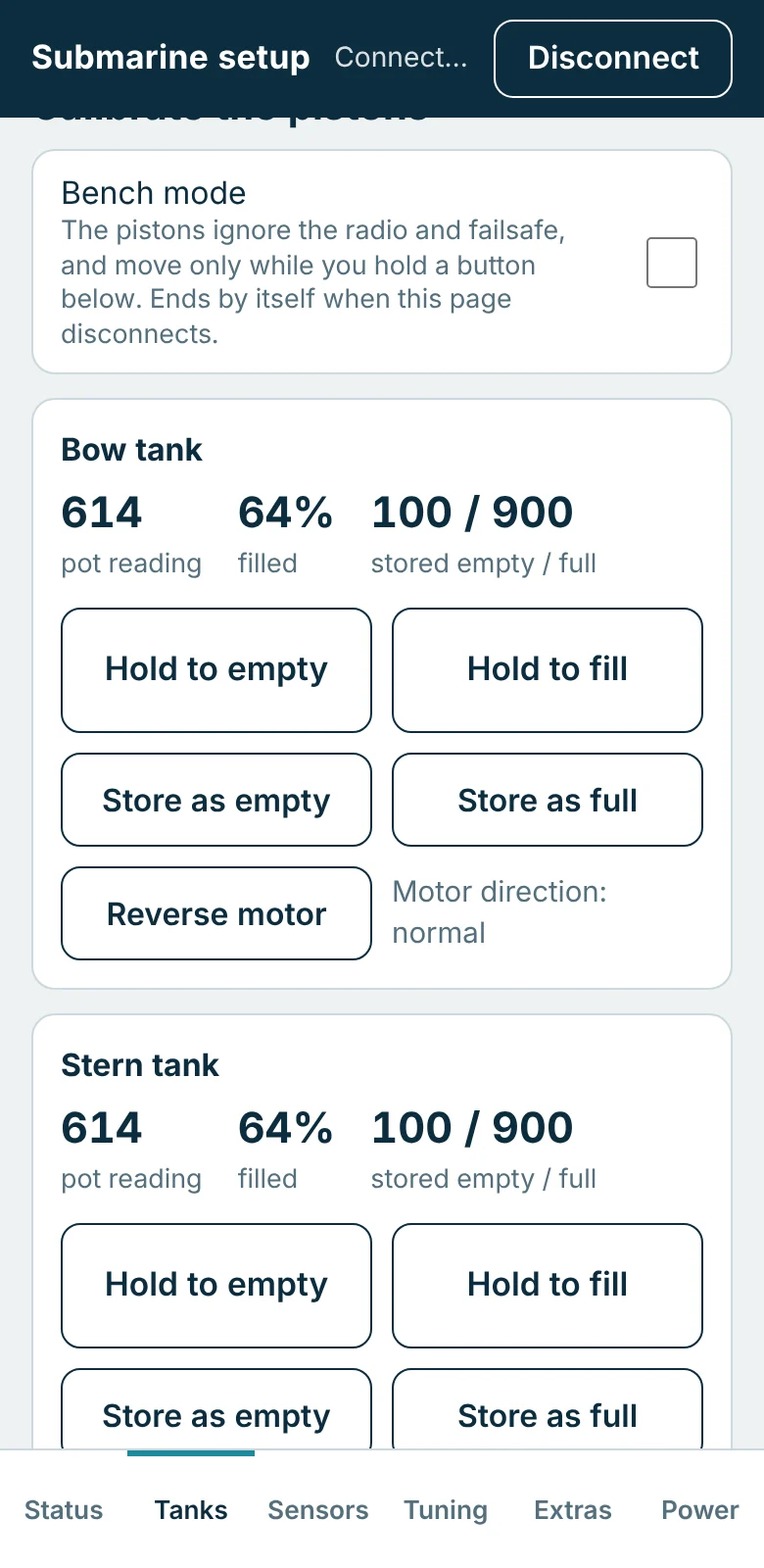
Setup page, Tanks tab: bench mode switch, and for the bow and stern tanks the pot reading, how full, and buttons to move the piston and store its end positions.
TanksTeach the board where each piston is empty and full.
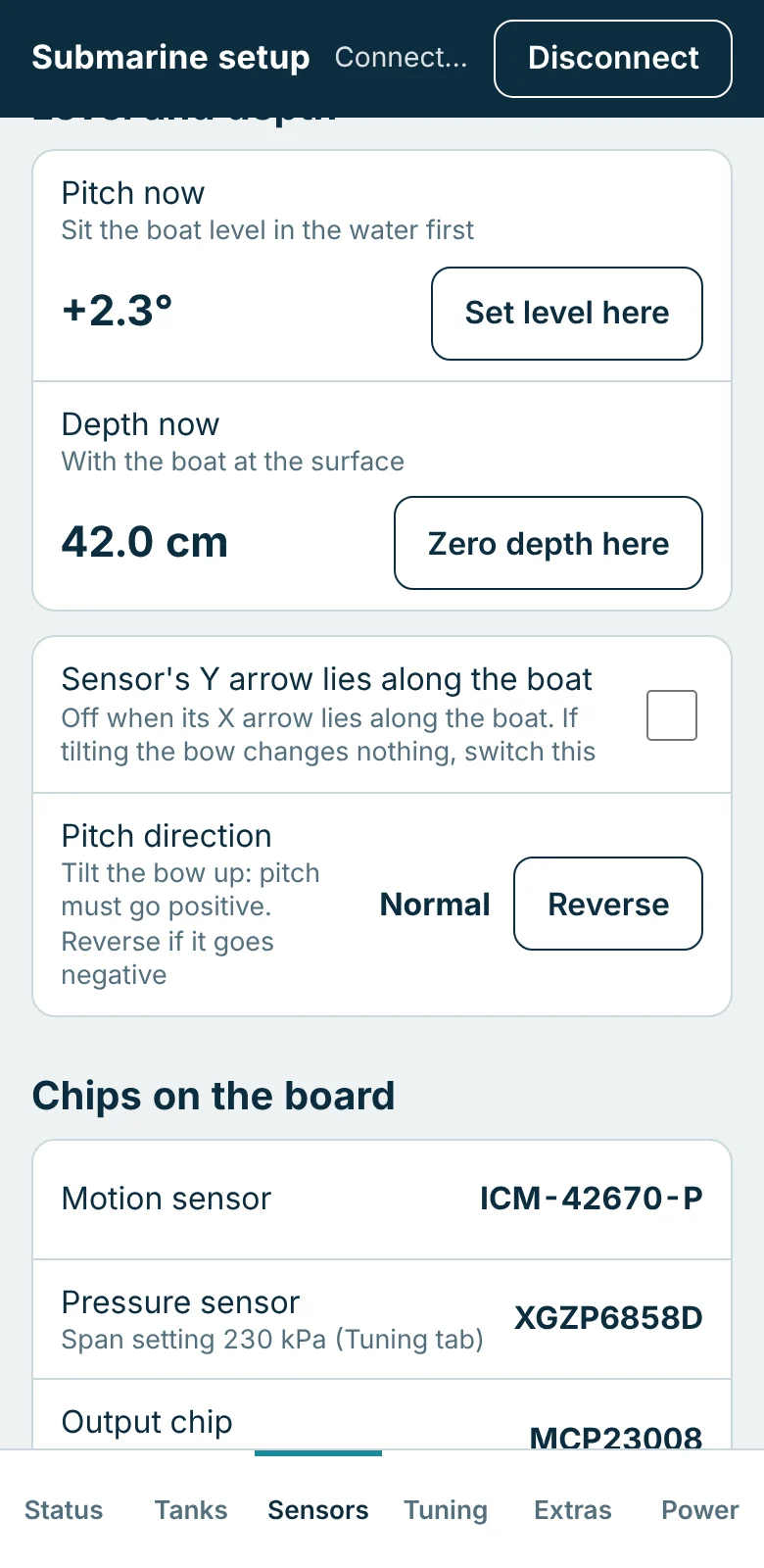
Setup page, Sensors tab: pitch now +2.3 degrees with a Set level here button, depth now 42.0 cm with a Zero depth here button, and the motion sensor, pressure sensor and output chip found on the board.
SensorsSet level, zero the depth, and see which chips the board has found.
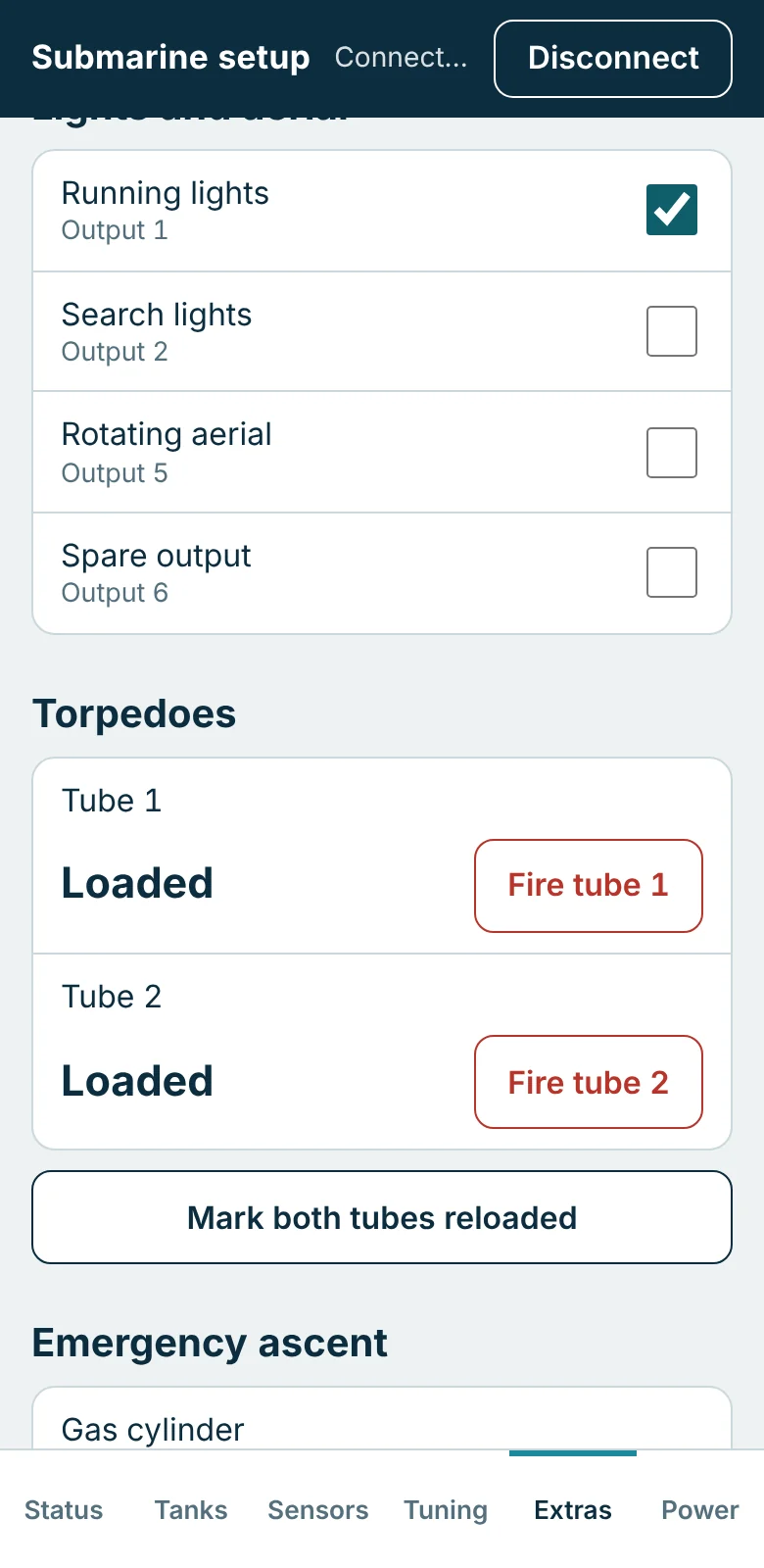
Setup page, Extras tab: switches for running lights, search lights, rotating aerial and spare output, and Fire buttons for two loaded torpedo tubes.
ExtrasTry the lights and the aerial, fire and reload the torpedo tubes.

These are pictures of the real setup page, served by the board's own firmware running on a computer against a simulated boat. No hardware was involved.

Failsafe

What the board does when something goes wrong

A submarine that loses its radio link is out of sight as well as out of reach. The Commander watches for trouble and acts on it without being told.

IfThe Commander
The radio signal is lost for a second

Drives both tanks empty and puts the front planes to full rise. The rear planes go on holding the boat level.

The boat goes deeper than the limit you set

The same emergency surfacing.

The depth reading is lost below 20 cm

The same emergency surfacing.

Water gets into the hull

Two probes, forward and aft, with a trip level you set. Surfaces, and flashes a code that says which end is wet.

The battery runs low

Warns first, with the boat still fully under control. Surfaces at the cut-off voltage.

The boat still has not come up

Opens a gas-cylinder valve by itself, once, after a delay you set. You can also blow from a switch on the transmitter.

The controller's program stops

A watchdog restarts it after two seconds. The power stays on meanwhile.

You walk away and leave it switched on

Switches itself off after ten minutes with no radio and no phone. The time can be changed.

Loss of signal is detected when the receiver stops sending servo pulses. A receiver that keeps sending them needs its own failsafe positions set to bring the boat up. More in the questions.
Source available

Nothing hidden in the box

The Commander's firmware and its setup page will be published in full when the campaign opens. You can read exactly what your boat's controller does, change it, and load your own version.

The controller itself is a stock Raspberry Pi Pico 2 W, soldered to the board. It is not locked in any way.

The source is finished and will be published with the campaign. The licence it is published under will be stated with it.

  • The firmware. One Arduino sketch, with plain-English comments throughout: what each setting does, and what each failsafe does and why.
  • The setup page. One HTML file. Open it on a computer and it runs against a pretend boat, so you can try a change before it goes near the water.
  • Free tools. It builds with the free Arduino program and the Arduino-Pico core. Nothing to buy and no account.
  • No programmer. Your own version loads over the Pico's USB socket, and the original goes back the same way.
  • The circuit too. The circuit diagram and the parts list come with the board, so it can be mended.

Why Kickstarter

A first batch, paid for by the people who want it

The model-submarine hobby is small, and a first batch of boards costs real money before the first one is sold. A campaign answers the one question that matters: are there enough of you?

All or nothing

The planned goal is £4,000. If pledges do not reach it, nobody is charged and no boards are made.

Only after trials

Kickstarter asks hardware projects to show a working prototype. So do we. The campaign opens only when a real Commander has run a real boat under water, on film.

Built and tested by hand

Each board will be assembled by hand in the UK and tested on a rig before it is posted.

Read the campaign plan

Where it stands

Honest progress

The Commander exists as a design, not as hardware. Here is what has been done and what has not.

Nothing will be offered until a Commander has been built, run on the bench and tried in the water. The dates are a plan, and every one of them moves if the trials find faults.

Join the launch list

  1. Circuit and board layout Done, as drawnThe Commander is drawn and laid out as a carrier for a Raspberry Pi Pico 2 W, with parts that are in current production. The layout passes the design-rule check and matches its circuit diagram connection for connection.
  2. Firmware DoneWritten, compiled for the Pico, and run on a computer against a simulated boat: more than 400 automatic checks on the firmware and its setup page.
  3. First boards To doA few boards made, assembled by hand and brought up on a bench supply.
  4. Water trials To doReal tanks, servos and a transmitter, in a boat, under water. Planned for early 2027.
  5. Kickstarter campaign To doThirty days, planned for April 2027. It opens only if the trials pass.
  6. First batch To doBuilt, tested and posted to backers. Planned for September 2027.

Want to back it on day one?

Join the launch list. It costs nothing and commits you to nothing. You get an email when the date is set and another the day the campaign opens, in time for the early-bird pledges.

Tell me when it launches